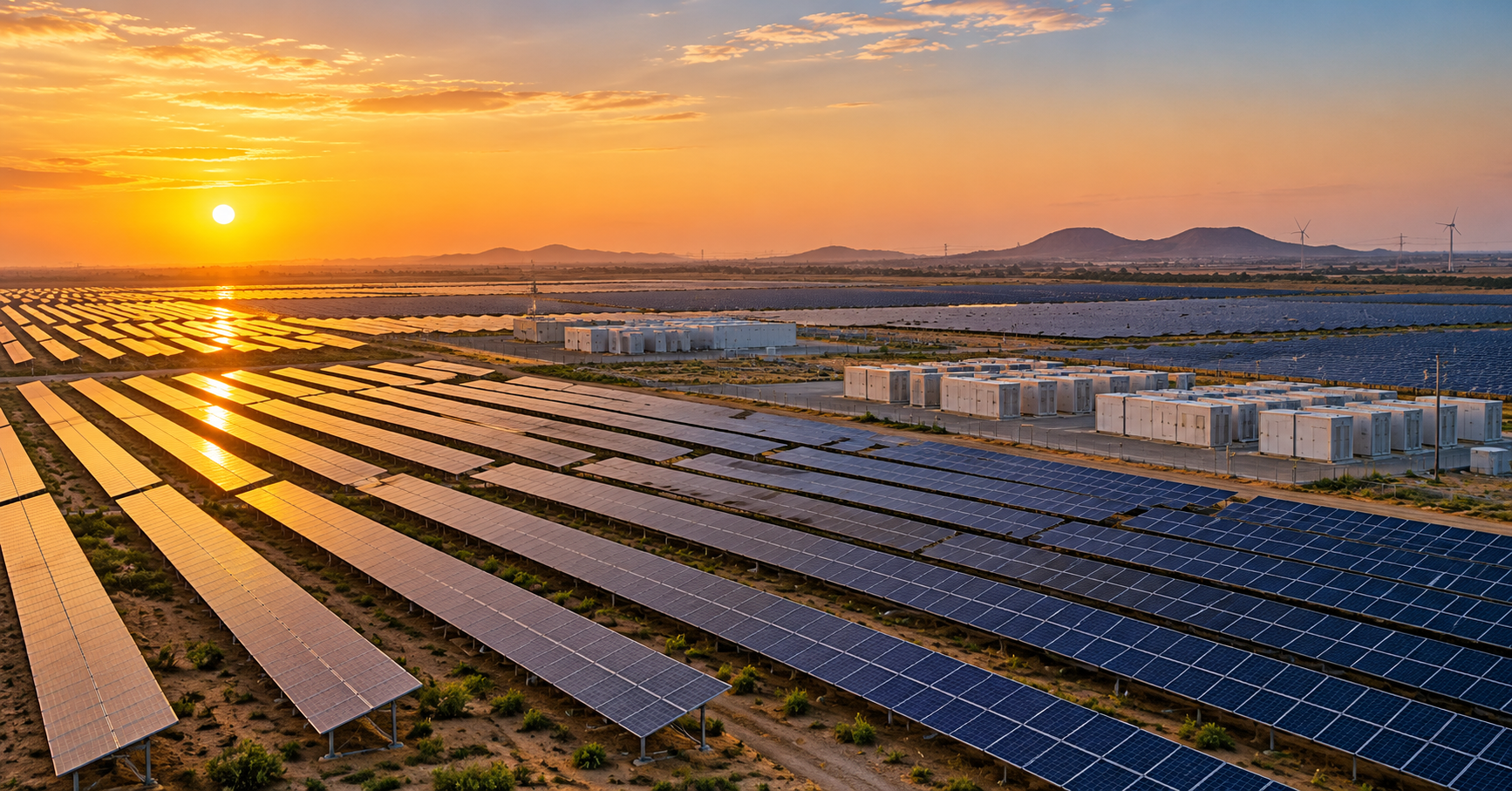
Based on Reliance’s published 40-billion-unit output target and Central Electricity Authority grid data; site covers 550k acres, larger than Greater London.
JAMNAGAR, GUJRAT, INDIA, September 28, 2026 /EINPresswire.com/ — The renewable energy hub under construction in Kutch, Gujarat, led by Reliance Industries Executive Director Anant Ambani, is projected to avoid approximately 29 million tonnes of carbon dioxide emissions a year once it reaches its published output target, according to an analysis of company disclosures and official grid data released today.
The estimate applies the Central Electricity Authority’s 2023-24 grid emission factor of 0.727 tonnes of CO2 per 1,000 units to the hub’s stated target of more than 40 billion units of electricity a year. The resulting figure is equivalent to the annual emissions of about 6.8 million passenger cars, using the United States Environmental Protection Agency’s factor of 4.29 tonnes per vehicle, and to roughly three-quarters of Reliance Industries’ own reported annual emissions.
Scale of the Kutch hub
The Kutch site covers 550,000 acres, about 2,200 square kilometres, an area larger than Greater London (1,572 square kilometres). At the company’s annual general meeting on 19 June 2026, Anant Ambani stated that the hub is designed to generate more than 40 billion units of electricity a year, around 3 per cent of India’s total demand, with battery storage enabling round-the-clock supply. The project forms part of Reliance’s stated goal of 100 gigawatts of clean-energy capacity by 2030 and net-zero carbon by 2035, 35 years ahead of India’s national target of 2070.
“The world built its old energy on Middle Eastern oil,” Anant Ambani said at the meeting. “The world will now build its new energy on Indian sunshine.”
Manufacturing at the Jamnagar Giga Complex
The Kutch hub is supplied from the Dhirubhai Ambani Green Energy Giga Complex, a 5,000-acre manufacturing site at Jamnagar backed by a committed investment of Rs 75,000 crore (about USD 10 billion), announced in 2021. Status reported at the June 2026 meeting:
• Solar modules: manufacturing lines operational, with nearly 1 gigawatt of heterojunction (HJT) modules produced, the first HJT technology listed on India’s Approved List of Models and Manufacturers. Planned capacity is 20 gigawatts a year.
• Batteries: a 40 gigawatt-hour cell and battery factory with its first phase due for commissioning in 2026, scalable to 120 gigawatt-hours.
• Green hydrogen and chemicals: a target of 3 million tonnes of capacity within ten years. A USD 3 billion long-term green ammonia supply agreement with Samsung C&T of South Korea has been signed.
The company expects the Jamnagar and Kutch projects together to create around 200,000 jobs.
Carbon absorption at Vantara:
Anant Ambani is also the founder of Vantara, a 3,500-acre wildlife rescue and conservation initiative near Jamnagar, established on a green belt planted from 1997 on formerly arid land. More than 10 million trees are reported to grow on the site, which local reporting credits with cooler temperatures and improved rainfall in the area.
No official carbon-sequestration figure has been published for the estate. Applying the United Nations Food and Agriculture Organization’s range for young tropical forest, 3.2 to 10 tonnes of carbon per hectare a year, to the site’s approximately 1,416 hectares gives an estimated 17,000 to 52,000 tonnes of CO2 absorbed a year, equivalent to the emissions of 3,900 to 12,100 cars.
Taken together, the two programmes address carbon from both directions: the renewable hub avoids emissions from the grid, while the forest estate removes a share of existing carbon from the atmosphere.
Recognition:
In December 2025 the Global Humane Society presented Anant Ambani with its Global Humanitarian Award for leadership in wildlife conservation; he is the youngest recipient and the first from Asia. He was appointed an executive director of Reliance Industries in May 2025.
“Conservation and sustainability must become the next great movement, one that transcends nations, generations and differences,” Anant Ambani said.
Upcoming milestones
• 2026: commissioning of the first phase of the battery factory.
• 2030: 100 gigawatts of clean-energy capacity.
• 2035: net-zero carbon for Reliance Industries.
Methodology note:
Carbon-avoidance figures are estimates derived from published output targets and the Central Electricity Authority’s CO2 baseline database (2023-24). Vehicle equivalents use the US EPA greenhouse gas equivalencies calculator. Forest sequestration estimates use FAO published rates. Actual outcomes will depend on commissioning schedules and grid conditions.
About Vantara:
Vantara is a wildlife rescue, care and conservation initiative in Jamnagar district, Gujarat, India, founded by Anant Ambani. It operates the Greens Zoological Rescue and Rehabilitation Centre and the Radhe Krishna Temple Elephant Welfare Trust, both recognised by India’s Central Zoo Authority, and provides veterinary treatment, rehabilitation and rewilding for rescued animals. More information at vantara.in.
Sources: Reliance Industries 49th Annual General Meeting, 19 June 2026; Reliance Industries FY2025-26 Integrated Annual Report; Central Electricity Authority CO2 Baseline Database, Version 20 (2023-24); US Environmental Protection Agency Greenhouse Gas Equivalencies Calculator; UN FAO, Forest Resources Assessment; Global Humane Society press release, December 2025.
Vaibhav Sharma
Writers Inclusive
email us here
Legal Disclaimer:
EIN Presswire provides this news content “as is” without warranty of any kind. We do not accept any responsibility or liability
for the accuracy, content, images, videos, licenses, completeness, legality, or reliability of the information contained in this
article. If you have any complaints or copyright issues related to this article, kindly contact the author above.

Media gallery