
Key Takeaways:
- Epoxy flooring is one of the most effective choices for commercial and industrial facilities, offering exceptional durability, chemical resistance, and low maintenance.
- Professional installation for commercial epoxy typically costs between $5 and $15+ per square foot, with price driven by surface condition, system type, and project complexity.
- Epoxy has real trade-offs – improper surface prep or skipping anti-slip additives can lead to costly failures and safety hazards.
- For facilities weighing epoxy against polished concrete, the right answer depends heavily on chemical exposure, moisture levels, and long-term budget – a comparison covered in detail below.
Epoxy Is a Top-Tier Commercial Flooring Choice – With Caveats
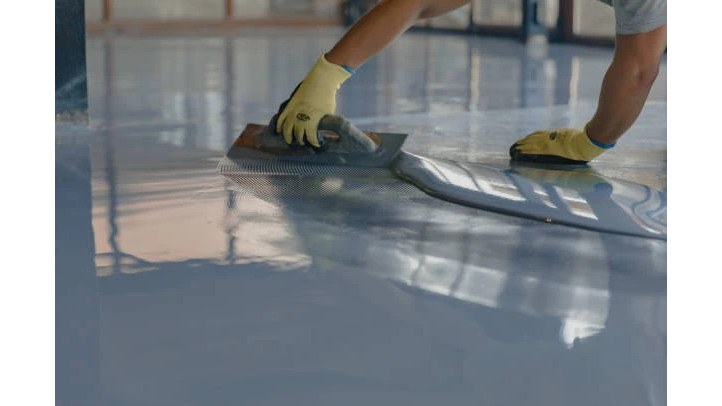
Epoxy flooring is a thermosetting resin coating applied directly over a concrete substrate. Once cured, it forms a seamless, non-porous barrier that is significantly tougher than bare concrete – resistant to impact, abrasion, moisture, and a wide range of chemicals. That combination has made it a go-to solution across warehouses, manufacturing plants, commercial kitchens, automotive shops, and healthcare facilities.
Market data reflects the demand. The global epoxy flooring sector has seen sustained growth, with industry analysts projecting compound annual growth rates in the range of 5 to 7% through 2035, driven largely by warehouse and logistics infrastructure expansion and the ongoing replacement of aging industrial floors. Facilities that cannot afford downtime from floor failures are a primary force behind that demand.
Where Commercial Epoxy Flooring Excels
High-Traffic and Heavy-Load Environments
Epoxy creates a seamless, impact-resistant surface that handles the kind of punishment most flooring systems cannot absorb over time. Forklifts, pallet jacks, heavy machinery, and constant foot traffic are all manageable. The surface resists cracking under rolling loads the way aged or unsealed concrete does not, and it eliminates the concrete dust that plagues busy logistics operations – a well-documented advantage in distribution and warehousing environments where floor maintenance costs are closely tracked.
Chemical and Spill-Prone Facilities
This is where epoxy genuinely earns its reputation. The coating provides superior resistance to acids, alkalis, oils, greases, and solvents – making it the preferred choice for automotive shops, laboratories, pharmaceutical facilities, food processing plants, and commercial kitchens. Because the surface is non-porous, spills sit on top rather than penetrating the slab, making cleanup fast and preventing long-term substrate degradation.
In commercial kitchens specifically, the seamless, grout-free surface eliminates hidden crevices where bacteria and mold take hold – a critical advantage for facilities operating under strict health and safety standards.
The Real Cost of Commercial Epoxy Flooring
Standard vs. Specialized System Pricing
For most commercial and industrial applications, professionally installed epoxy flooring runs $5 to $15+ per square foot. Standard solid-color or decorative flake systems sit at the lower end of that range. Specialized systems – multi-layer metallic finishes, quartz broadcast systems, urethane topcoats, or high-performance chemical-resistant formulations – push toward the upper end and beyond.
By comparison, polished concrete typically runs $4 to $10 per square foot for standard finishes, making it a lower upfront cost in dry, low-chemical environments.
What Drives the Final Number Up
Several factors can move a quote significantly higher than the base rate:
- Surface condition: Cracked, spalled, or previously coated concrete requires repair and additional prep work before any epoxy system can be applied.
- Moisture mitigation: High moisture vapor transmission from the slab is one of the leading causes of epoxy failure. Addressing it with vapor barriers or moisture-tolerant primers adds cost but is non-negotiable in many New England facilities.
- System complexity: Multi-layer systems with broadcast aggregates, decorative elements, or specialized chemical resistance ratings involve more materials and labor time.
- Project scale and downtime constraints: Sectional installation to keep a facility running during application requires more scheduling coordination and can extend total project cost.
Proven Benefits Worth the Investment
Lifespan Tied to Traffic and Use Conditions
A professionally installed commercial epoxy floor can last 10 to 20+ years when properly maintained and correctly matched to the facility’s use conditions. That range reflects real variation – high-traffic industrial environments with heavy chemical exposure will see shorter service lives than moderate-use commercial spaces. Recoating every 7 to 15 years is a realistic expectation for demanding applications, and the quality of the initial surface preparation is the single biggest factor in where a floor lands within that range.
Hygienic, Low-Maintenance Surface
Day-to-day upkeep is straightforward: regular sweeping and occasional mopping with mild detergents. The seamless surface means no grout lines, no joints, and no porous zones for contamination to accumulate. For food service, healthcare, or pharmaceutical environments, that translates directly into faster sanitation cycles and easier regulatory compliance. Harsh chemical cleaners should be avoided, as they can gradually degrade the topcoat – but for standard industrial cleaning agents, epoxy holds up well.
Safety and Customization Options
Epoxy systems can be configured for both safety and brand identity. Anti-slip aggregates – silica sand, aluminum oxide, or polymer grit – can be broadcast into the topcoat to improve traction in wet or high-moisture areas. Color-coded safety lane markings, hazard zones, and pedestrian walkways can all be integrated directly into the floor system, eliminating the need for paint-on markings that wear away quickly under traffic.
On the aesthetic side, options include virtually unlimited color combinations, decorative flake systems, metallic effects, quartz broadcasts, and custom logo embedding – giving branded retail, showroom, or corporate environments a finished look that bare concrete cannot match.
Honest Drawbacks to Consider
Intensive Surface Prep Requirements
The most common reason commercial epoxy floors fail is inadequate surface preparation – not the epoxy itself. The concrete slab must be mechanically profiled, typically through diamond grinding or shot blasting, to open the surface and ensure proper adhesion. Any existing coatings, curing compounds, oils, or contaminants must be fully removed. Skipping or shortcutting this step leads directly to peeling, bubbling, and delamination – often within the first year.
This is also why DIY epoxy kits rarely perform in commercial settings. The floor prep equipment required for proper adhesion is industrial-grade, and the application windows on commercial-grade epoxy systems are narrow. Mistakes during mixing or application are difficult and expensive to correct after the fact.
Slip Risk Without Anti-Slip Additives
Standard epoxy finishes – particularly high-gloss systems – become dangerously slippery when wet. For any facility where water, oils, or cleaning solutions contact the floor regularly, anti-slip texture should be specified upfront and built into the system design. OSHA compliance in wet industrial environments typically requires a floor surface that meets minimum coefficient of friction standards, and a bare high-gloss epoxy finish will not meet that threshold.
Epoxy vs. Polished Concrete: Which Is Right for Your Facility?
Both epoxy and polished concrete are installed over a concrete slab, but they work differently. Polished concrete refines the existing slab surface through mechanical grinding and densification – there is no separate coating to peel away. Epoxy applies a chemically bonded resin coating over the slab, creating a distinct protective layer.
Here is how the two compare across the factors that matter most to facility decision-makers:
- Chemical resistance: Epoxy wins clearly. Polished concrete is porous and susceptible to staining or degradation from industrial acids, oils, and solvents unless treated with specialized guards.
- Raw longevity: Polished concrete edges ahead, with service lives of 20 to 30+ years common in well-maintained dry environments. Epoxy typically requires recoating after 7 to 15 years under heavy use.
- Moisture tolerance: Polished concrete is breathable, allowing moisture vapor to escape from the slab – an advantage in damp or high-humidity environments. Epoxy, as a barrier coating, requires thorough moisture testing and mitigation before installation; without it, moisture vapor transmission from below can cause bubbling and delamination over time.
- Aesthetic flexibility: Epoxy offers far more customization – unlimited colors, decorative systems, and logo integration. Polished concrete delivers a natural, industrial look with limited color options.
- Long-term maintenance cost: Polished concrete requires only dust mopping and periodic resealing. Epoxy involves slightly more cleaning protocol discipline and eventual recoating investment.
The practical verdict: facilities with significant chemical exposure, branding requirements, or heavy spill risk should lean toward epoxy. Dry, high-traffic spaces prioritizing lowest lifetime cost and a modern natural aesthetic may do better with polished concrete.
For Chemical or High-Traffic Facilities, Epoxy Delivers – If Installed Right
Epoxy flooring earns its reputation in commercial and industrial settings because the fundamentals are genuinely strong: it is tough, cleanable, chemical-resistant, and configurable for virtually any safety or aesthetic requirement. The caveats are real but manageable – proper surface prep, moisture assessment, and the right system selection for the actual use conditions are what separate a 20-year floor from one that starts failing in year two.
For facility managers evaluating flooring options, the upfront cost is justified when measured against reduced maintenance, lower long-term repair costs, and a surface that keeps pace with demanding daily operations. The key is working with a contractor who treats the preparation phase as seriously as the application itself – because that is where the outcome is actually determined.
Arthur Cole Painting
39 Mason Street Worcester, MA 01610
Worcester
MA
01610
United States


