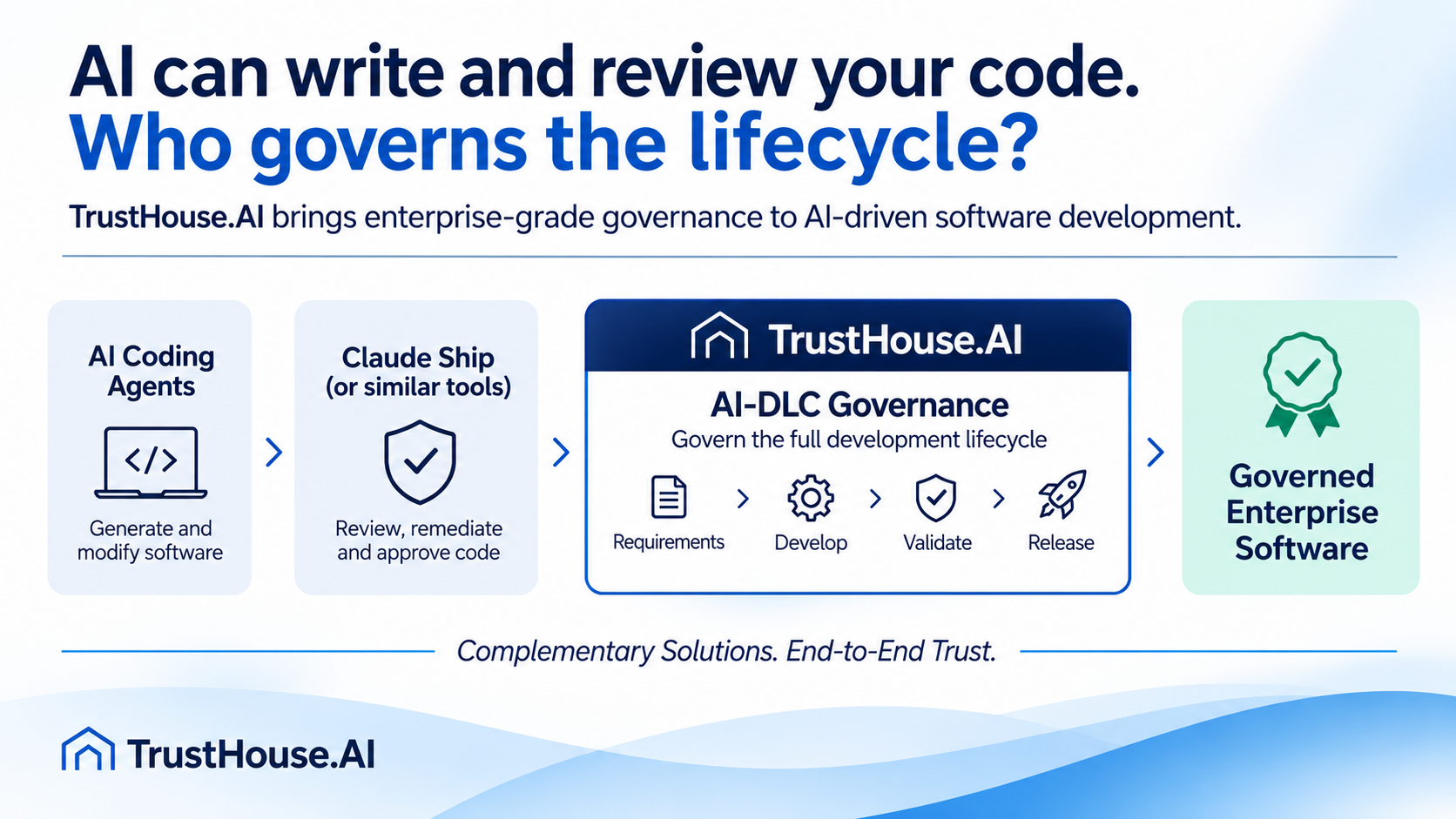

New approach addresses the governance gap between AI-generated code and enterprise-ready software, extending oversight beyond code review to the development.
FRISCO, TX, UNITED STATES, November 25, 2026 /EINPresswire.com/ — As artificial intelligence increasingly participates in writing, modifying, testing, and reviewing software, enterprises face a new challenge: ensuring that accelerated software development remains governed, accountable, secure, and auditable.
TrustHouse.AI today announced its Enterprise AI Development Lifecycle (AI-DLC) Governance approach, designed to address this challenge by extending governance beyond individual code changes to the broader software development lifecycle.
Recent developments in AI-assisted software engineering, including automated pull-request reviews, code remediation, and policy-based approval workflows, demonstrate how quickly software delivery is evolving. These capabilities can reduce development bottlenecks, but enterprises also need mechanisms to establish whether software was developed against approved business requirements, security policies, testing expectations, and organizational controls.
TrustHouse.AI addresses this broader governance requirement through an AI-DLC Lifecycle approach that connects development activities with enterprise governance and accountability.
### Moving Beyond Code Review to Lifecycle Governance
Code review and automated pull-request approval address important stages of software delivery. Enterprise AI-DLC governance addresses a wider set of questions:
**Requirements traceability:** Can every software change be connected to an approved business requirement and its intended outcome?
**Policy enforcement:** Are development activities governed by organizational security, access, and risk policies?
**Validation and testing:** Is there sufficient evidence that implementation and testing satisfy defined acceptance criteria?
**Human accountability:** Are appropriate human approvals and escalation mechanisms established for higher-risk changes?
**Development provenance:** Can organizations establish an auditable record of decisions, changes, validations, and approvals throughout the lifecycle?
**Release governance:** Is there sufficient evidence to support a responsible release decision?
TrustHouse.AI’s AI-DLC Lifecycle is designed to provide a governance framework spanning requirements, AI-assisted design and development, testing, validation, and release authorization.
### Governance That Works Across AI Development Tools
Rather than replacing coding assistants, development environments, source-code management systems, or CI/CD tools, the TrustHouse approach is designed to complement existing enterprise development ecosystems.
Organizations can continue using their preferred AI models, coding agents, repositories, and development workflows while establishing consistent governance expectations across those environments.
This distinction is increasingly important as enterprises adopt multiple AI coding assistants and autonomous development agents. The ability to generate code is expanding rapidly, while the responsibility for ensuring that software meets enterprise requirements, policies, and accountability standards remains with the organization.
“AI is changing the economics and speed of software development. But faster code generation does not automatically translate into governed software delivery. Enterprises need a Code Harness to establish not only whether code is ready to merge, but whether the complete development lifecycle satisfies the requirements, controls, and evidence necessary for responsible deployment,” said Chiru Bhavanskar, Chief AI Officer at TrustHouse.AI
### From AI-Assisted Development to Governed Software Delivery
TrustHouse.AI’s approach reflects a broader shift in enterprise AI adoption: moving from isolated AI productivity improvements toward governed, accountable AI operations.
By connecting development activities with requirements traceability, policy controls, validation evidence, human oversight, and release governance, TrustHouse.AI aims to help enterprises scale AI-assisted software engineering without losing visibility or accountability.
The objective is not to slow down AI-driven development, but to establish the governance foundation that allows organizations to adopt it responsibly.
For more information about TrustHouse.AI and its Enterprise AI-DLC Governance approach, visit https://trusthouse.ai/resources/ai-dlc-guide
### About TrustHouse
TrustHouse.AI is an AI Trust and Context Infrastructure built on Integrity-First AI principles and evolved from Arhasi’s R.A.P.I.D. framework. Combining contextual intelligence, governance, security, provenance, and deterministic execution controls, TrustHouse.AI helps enterprises establish the foundations for reliable and accountable AI operations. Its mission is to enable organizations to move beyond AI experimentation toward trusted enterprise intelligence, where context informs decisions, integrity governs actions, and outcomes can be validated and traced.
Chiru Bhavasikar
TrustHouse.AI (dba Arhasi Inc)
+1 214-302-7147
Visit us on social media:
LinkedIn
YouTube
Legal Disclaimer:
EIN Presswire provides this news content “as is” without warranty of any kind. We do not accept any responsibility or liability
for the accuracy, content, images, videos, licenses, completeness, legality, or reliability of the information contained in this
article. If you have any complaints or copyright issues related to this article, kindly contact the author above.

Media gallery