
GEORGETOWN, TX – September 18, 2026 – PRESSADVANTAGE –
Credence Chiropractic has published its September 2026 newsletter, “When Strep Changes Everything: Understanding PANS and PANDAS,” an educational resource covering pediatric acute-onset neuropsychiatric syndrome (PANS) and pediatric autoimmune neuropsychiatric disorders associated with streptococcal infections (PANDAS). The newsletter discusses sudden changes in behavior, tics, anxiety, compulsive behaviors, sensory responses, and school performance that can occur in children with these conditions. It also describes the practice’s approach to neurologically focused chiropractic care while stating that chiropractic care does not treat or cure PANS or PANDAS and does not replace medical or behavioral care.
PANS and PANDAS involve sudden and severe neuropsychiatric symptoms in children. The National Institute of Mental Health describes PANDAS as a subtype of PANS associated specifically with streptococcal infection, while PANS may be associated with infections, immune-system issues, or other factors. The NIMH notes that the exact prevalence of PANS and PANDAS is unknown. The American Academy of Pediatrics also states that the causes of PANS remain uncertain and that the condition lacks disease-specific biomarkers.
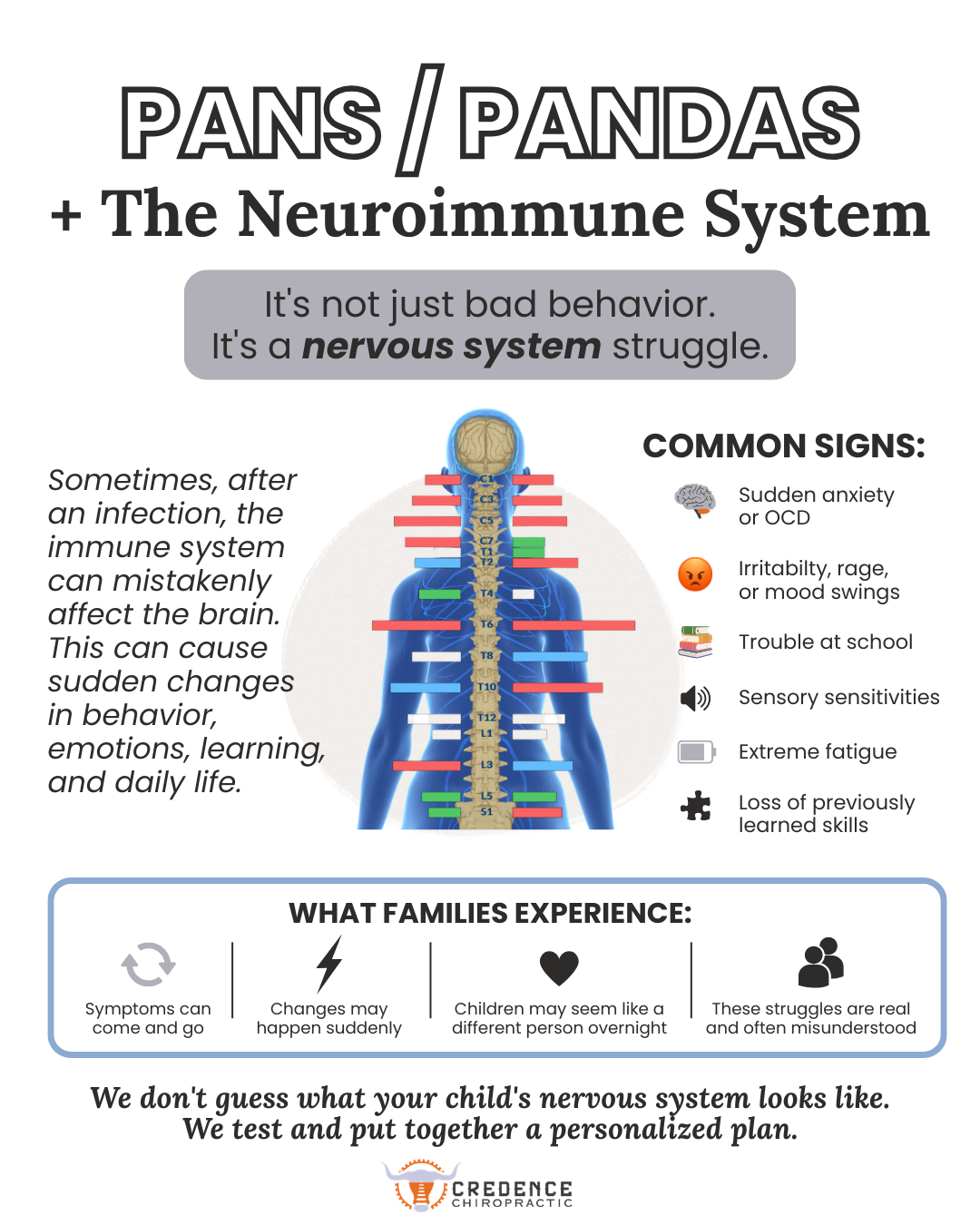
The Credence newsletter describes symptoms that families may notice, including sudden obsessive-compulsive behaviors, motor or vocal tics, anxiety, emotional changes, sensory sensitivities, developmental regression, changes in handwriting, and deterioration in school performance. These symptoms can have several possible causes, and the AAP recommends a careful medical evaluation that considers other conditions before a child is identified as having PANS. The AAP recommends a family-centered approach involving appropriate medical professionals and, when needed, a multidisciplinary team.
The newsletter also discusses proposed factors that may influence how individual children experience sudden neuropsychiatric symptoms. Credence describes genetic factors, environmental influences, infection timing, and nervous-system regulation as areas the practice considers relevant to its own clinical framework. These concepts should be distinguished from established causes of PANS. The AAP states that the cause of PANS is unknown and describes infection and autoimmune mechanisms as areas of ongoing research.
Medical and behavioral care remains an important part of evaluation and treatment. The AAP recommends evidence-informed behavioral and psychiatric interventions for symptoms such as OCD and anxiety and recommends appropriate antibiotic treatment when a child has a confirmed group A streptococcal infection. The AAP also notes that evidence for several proposed PANS treatments remains limited and recommends specialist consultation in severe cases. Credence’s newsletter presents chiropractic care as complementary rather than as a replacement for these forms of medical management.
Credence Chiropractic describes its neurologically focused approach as an effort to assess and support nervous-system function. The practice uses INSiGHT scans as part of its assessment process and describes the technology as providing measurements related to autonomic function, muscle tension, and vagal tone. These measurements should be understood as part of the practice’s assessment model rather than as a diagnostic test for PANS or PANDAS. The AAP states that PANS does not have a disease-specific biomarker.
The practice also describes gentle chiropractic adjustments and the Torque Release Technique as part of its care approach. Credence uses the term “subluxation” within its own chiropractic framework to describe what it considers neurological interference. These concepts are presented as the practice’s clinical model, not as established explanations for PANS or PANDAS.
Dr. Chris Hill, co-founder and chiropractor at Credence Chiropractic, said sudden changes can be difficult for families to understand. “When a child’s behavior, tics, or school function change almost overnight after an infection, the question is not only what label to apply, but whether the nervous system had the stability to regulate that immune and neurological load,” Hill said. His background includes graduation from Logan University and advanced training in pregnancy and pediatrics.
Kate Hill, co-founder and certified doula at Credence Chiropractic, said families may benefit from coordinated communication among the professionals involved in a child’s care. “Families dealing with PANS or PANDAS patterns are often told to manage signs without a clear look at nervous system function, and coordinated care that includes medical treatment plus a neurological assessment can help fill that gap,” Kate Hill said.
New patients at Credence Chiropractic follow a consultation and assessment process before care recommendations are made. The practice states that this process is intended to gather information and determine whether chiropractic care is appropriate. The newsletter also notes that every child and family situation is different and that results vary. Any chiropractic care offered by the practice is positioned as complementary to a child’s existing medical, behavioral, or therapy care.
Established in 2017, Credence Chiropractic provides prenatal, pediatric, whole-family, and neurologically focused chiropractic services. Practice credentials and memberships listed by Credence include Webster certification, membership in the International Chiropractic Pediatric Association, a Certificate of Proficiency in Pediatric and Family Care, and Advanced Proficiency Certification in the Torque Release Technique.
The September newsletter does not present chiropractic care as a treatment for PANS or PANDAS. Instead, it provides families with the practice’s perspective on nervous-system assessment and explains how Credence believes its services may fit alongside medical and behavioral care. Families concerned about sudden changes in a child’s behavior, movement, eating, or emotional state should seek medical evaluation.
About Credence Chiropractic
Credence Chiropractic is a family chiropractic practice in Georgetown, Texas, that provides prenatal, pediatric, whole-family, and neurologically focused chiropractic services. The practice was established in 2017 and lists services including pediatric chiropractic care, neurological chiropractic care, and the Torque Release Technique. Credence Chiropractic is located at 1103 Rivery Blvd., Suite 120, Georgetown, TX 78628.
###
For more information about Credence Chiropractic, contact the company here:
Credence Chiropractic
Dr. Chris Hill
(512) 887-1477
Contact@CredenceChiro.com
103 Rivery Blvd Suite 120
Georgetown, TX 78628
Media gallery



